NASA: distributed computing with Stardust@Home 01.02.2006
Want to help at NASA’s comet sample return mission? Remember “SETI@home” where internet users shared CPU usage of their home computers to help searching for artificial radio wave signals in the universe? You can answer at least one of two questions with “yes”? Than here might be something interesting for you: Now you can be part in an Internet-based search for dust grains originating from stars hundreds of thousands of light years away.
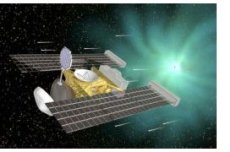 In a new project called “Stardust@home” researchers from the University of California, Berkeley, invite Internet users to help them search for a few dozen submicroscopic grains of interstellar dust captured by NASA’s “Stardust” spacecraft which returned to Earth on January 15th, 2006. The Stardust spacecraft collected not only interstellar dust particles, but dust from the tail of comet “Wild 2″ as well. It is expected, that the dust is dating from 10 million to 4.5 billion years ago.
On February 15th, 2006 scientists will start scanning the dust collector and on March 1st, 2006 the first image data will be available for searching. The search will probably be completed in October 2006.
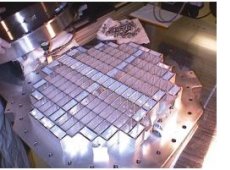 Based on previous measurements of interstellar dust by both the Ulysses and Galileo spacecrafts, scientist expect to find approximately 45 grains of submicroscopic dust in the collector, a mosaic of tiles of lightweight aerogel forming a disk. Though those searching for pieces of Wild 2’s tail will easily be able to pick out the thousands of cometary dust grains embedded in the front of the detector, finding the 45 or so grains of interstellar dust stuck in the back of the detector won’t be so easy.
The Space Sciences Laboratory has created a “virtual microscope” that will allow anyone with an Internet connection to scan some of the 1.5 million pictures of the aerogel for tracks left by speeding dust. Each picture will cover an area smaller than a grain of salt.
 “Twenty or 30 years ago, we would have hired a small army of microscopists who would be hunched over microscopes focusing up and down through the aerogel looking for the tracks of these dust grains,” said Westphal. “Instead, we developed an automated microscope to scan the aerogel and hope to use volunteers we have trained and tested to search for these tracks.”
The Web-based virtual microscope will be made available to the public in mid-March, even before all the scans have been completed in a cleanroom at Houston’s Johnson Space Center. In all, Westphal expects to need some 30,000 person hours to look through the scanned images at least four times. Searching each picture should take just a few seconds, but the close attention required as the viewer repeatedly focuses up and down through image after image will probably limit the number a person can scan in one sitting.
 Once the grains are identified and analyzed, scientist hope, that the information will tell about the internal processes of distant stars such as supernovas, flaring red giants or neutron stars that produce interstellar dust and also generate the heavy elements like carbon, nitrogen and oxygen necessary for life.
In recognition of the critical importance of the Stardust@home volunteers, the discoverer of an interstellar dust particle will appear as a co-author on any scientific paper by the Stardust@home collaboration announcing the discovery of the particle.
Weblinks:
- Stardust@home: http://stardustathome.ssl.berkeley.edu/
- NASA’s Stardust Mission: http://stardust.jpl.nasa.gov/home/
- The Story of Stardust@Home
- Planetary Radio: Stardust Samples Streak Safely Home
- Posted in : Uncategorized
- Author : Oliver
flickr images with "22C3"-tag:


Comments»
no comments yet - be the first?